
Chapter 4 · Grades 4–6
Antarctica glossary
New science words are easier when we unpack them. Use this page whenever a word in the Antarctica chapters makes you pause.
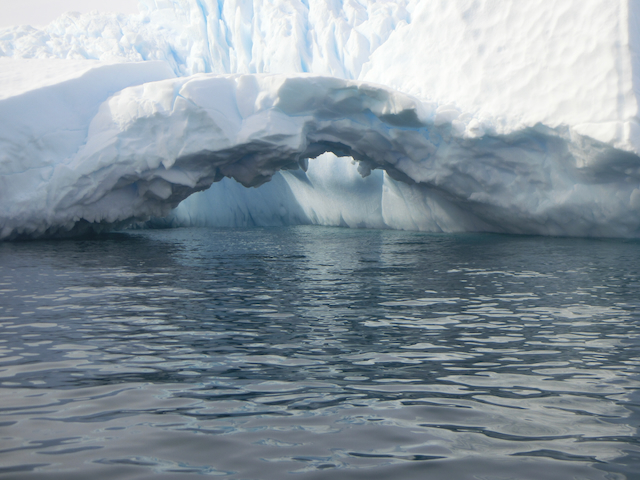
Iceberg arch · WindWalker Antarctic photo archive
You do not need to memorize every word
Choose the group that matches what you are reading. Say the word aloud, read its meaning, and then try using it in your own sentence.
Where are we?
Places and people
- Antarctica
- The ice-covered continent around the South Pole. It is land surrounded by the Southern Ocean.
- Antarctic
- A describing word for Antarctica or the cold region around it, as in “Antarctic wildlife.”
- Arctic
- The region around the North Pole. Unlike Antarctica, it is mainly an ocean surrounded by continents.
- Continent
- One of Earth’s seven largest areas of land. Antarctica is the southernmost continent.
- Expedition
- An organized journey with a purpose, such as exploration, scientific research, or discovery.
- Research station
- A group of buildings where scientists and support teams live and work while studying Antarctica.
- South Pole
- Earth’s southernmost point. It sits on the Antarctic ice sheet, above land.
- Southern Ocean
- The cold ocean that circles Antarctica and connects the Atlantic, Pacific, and Indian oceans.
- Sub-Antarctic
- The cold islands and ocean north of Antarctica but south of warmer parts of the world.
Built to survive
Life and wildlife
- Adaptation
- A body feature or behavior that helps a living thing survive where it lives.
- Blubber
- A thick layer of fat beneath the skin that stores energy and helps seals and whales stay warm.
- Breathing hole
- An opening in sea ice where an air-breathing animal can surface. Weddell seals use their teeth to keep some holes from freezing shut.
- Camouflage
- Colors, patterns, or shapes that help a living thing blend into its surroundings.
- Colony
- A large group of animals of the same kind living, resting, or nesting together.
- Crèche (say: kresh)
- A group of penguin chicks that stay together for warmth and safety while their parents search for food.
- Fledging
- The stage when a young bird grows the feathers it needs to leave its nesting place. A penguin chick needs waterproof feathers before entering the sea.
- Flipper
- A broad, flat limb used for swimming. Penguin flippers are modified wings; seal flippers are modified limbs.
- Habitat
- The natural home that gives a living thing the food, water, shelter, and space it needs.
- Huddle
- To crowd close together for warmth or protection. Emperor penguins take turns moving through a huddle.
- Marine mammal
- A warm-blooded animal that breathes air, feeds its young milk, and depends on the ocean. Seals and whales are marine mammals.
- Molt / moult
- To replace old feathers or fur with a new covering. “Molt” is the usual U.S. spelling; “moult” is used in British English.
- Penguin
- A flightless seabird with waterproof feathers and wings adapted as swimming flippers.
- Seal
- An air-breathing marine mammal with a streamlined body and four limbs shaped as flippers.
- Waterproof
- Able to keep water from passing through. A penguin’s overlapping feathers help keep icy water away from its skin.
Follow the energy
Food-web words
- Food chain
- One path showing how food and energy pass from one living thing to the next.
- Food web
- Many connected food chains. It shows that most animals eat—and may be eaten by—more than one kind of living thing.
- Keystone species
- A species with an especially important job in its ecosystem. Antarctic krill support many parts of the Southern Ocean food web.
- Krill
- Small, shrimp-like ocean animals that gather in swarms and feed penguins, fish, seals, seabirds, and whales.
- Phytoplankton (say: fy-toh-PLANK-tun)
- Tiny plant-like drifters that use sunlight to make food. They form the beginning of many ocean food chains.
- Predator
- An animal that hunts another animal for food. A leopard seal can be a penguin’s predator.
- Prey
- An animal hunted by a predator. The same animal can be predator in one food chain and prey in another.
Not all ice is alike
Ice and ocean
- Freshwater
- Water containing very little salt. Antarctic snow, glaciers, and the ice sheet are frozen freshwater.
- Glacier
- A large body of land ice that moves slowly downhill under its own weight.
- Iceberg
- A piece of land ice that breaks from a glacier or ice shelf and floats in the ocean.
- Ice sheet
- An enormous layer of ice covering a very large area of land. Antarctica holds Earth’s largest ice sheet.
- Land ice
- Ice made from layers of snow that build up on land. Glaciers and ice sheets are land ice.
- Sea ice
- Frozen ocean water that forms, floats, grows in winter, and partly melts in summer.
- Sea level
- The average height of the ocean’s surface, used as a starting point for measuring height and depth.
Patterns and change
Weather and climate
- Atmosphere
- The blanket of gases surrounding Earth. It contains the air we breathe and helps control temperature.
- Carbon dioxide
- A gas found naturally in the atmosphere. Burning coal, oil, and gas adds extra carbon dioxide, which increases warming.
- Climate
- The usual pattern of weather in a place measured over many years.
- Climate change
- Long-term changes in climate, including warmer average temperatures and changes in ice, oceans, weather, and habitats.
- Greenhouse gas
- A gas that traps some heat in Earth’s atmosphere, rather like a blanket. Carbon dioxide is one greenhouse gas.
- Weather
- What the air and sky are doing now or soon, such as snowing, blowing, warming, or clearing.